I wish I knew this all along my life and was explicitly covered in the syllabus of all the thermodynamics courses I ever took. Unfortunately, I was deprived of that knowledge until I went to my favorite Chinese buffet restaurant with my friend around 6 months ago. While having my seventh plate of Chinese food, my friend told me something I have been looking for quite some time by then. I have tried ‘eating healthy’ for the last 3 years at least. I heard rice is bad, I stopped eating rice. I heard avocado is good, I bought dozens of it. I was not sure why I was still gaining weight after all those ‘healthy habits’! To all that health advice there is only one underlying absolute truth, everything else is derived from that, and that my friend is thermodynamics.
Your body is an open thermodynamic system interacting with the surrounding. You have one main energy input, what you eat. You have two main outputs, the metabolic energy your body needs to keep you alive or the basal metabolic rate (BMR), and the active energy you spend moving around. Now what will leave your weight unaltered, nothing gained, nothing lost?
By applying conservation of energy (very loosely), in a equilibrium state:
Total energy input = total energy output
or, Calories you eat = your BMR + active energy —- (1)
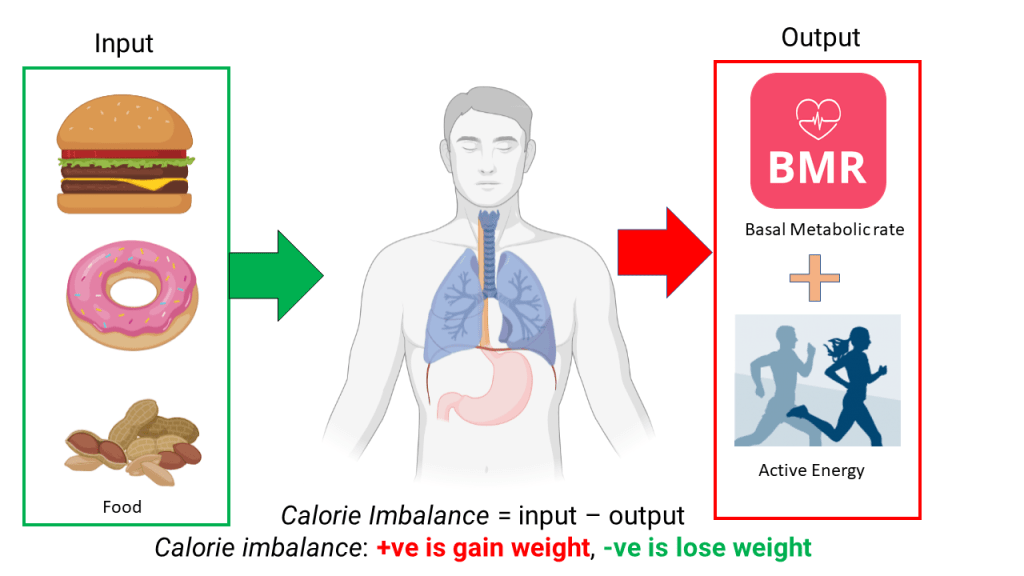
Now you are reading this because you probably do not want your weight to be standstill or in equilibrium. So, we need to add another layer of complication and introduce a new term called the ‘calorie imbalance’, which is defined as follows:
Daily calorie imbalance = total energy input – total energy output
or, Daily calorie imbalance = calories you eat – your BMR – active energy —- (2)
Now let us talk about how to get values of every term of RHS of eq. (2).
Calories you eat:
Measure everything you eat and log everything. Buy a food scale and a spoon measure. Your body is already keeping a meticulous log of what you eat, now it is your choice if you want to have that information or not. Use LoseIt website and free app version (available in iOS and Android) to scan every food item you eat, like a maniac, because your body is already keeping track of every grain of sugar you put in, just like another maniac! Measure everything you put into making a dish. Sounds crazy I know, but the good news if you have to do it until you know the ingredients that matter. Do it until you know a tablespoon of olive oil is 120Kcal, 32g of Peanut butter is 188Kcal, 100g of chicken breast is 165Kcal. Do until you can literally look at a plate and can say how much calories it is (which will not take long). Then while making a dish you will know what items you can ignore and what you must measure. Know how much oil you are putting in a dish and how many calories that is.
Example of a calorie log:

Your BMR:
This is easy. Calculate here: https://www.calculator.net/bmr-calculator.html
Active energy:
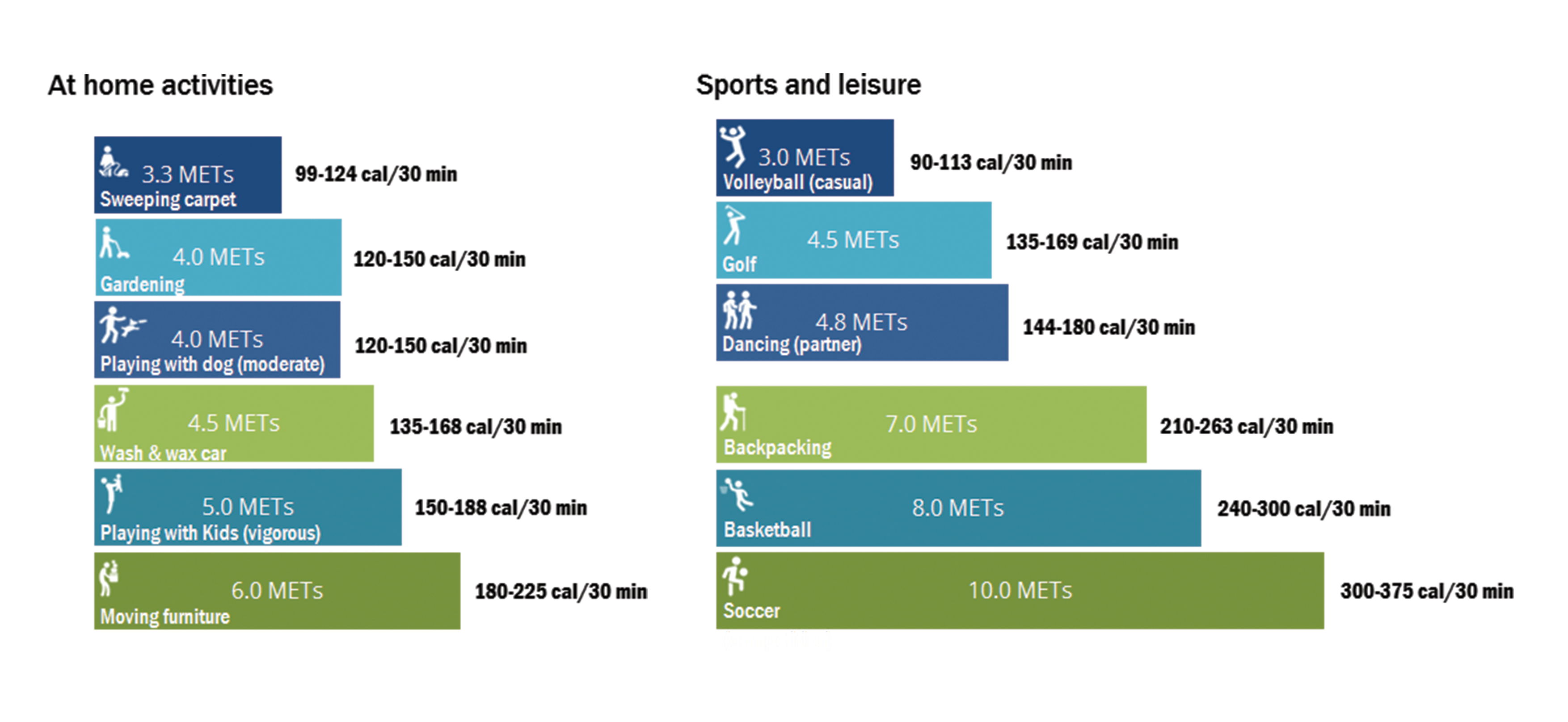
This one is a little tricky. If you own an Apple Watch, problem solved, ask it to measure it. If not, refer to charts like this for a rough estimate and learn about the metabolic equivalent of a task. LoseIt has some of the values built for you to log. Let me give you some ballpark amount: normal day to day activity, with 1h of walking, 2-3 hours of standing, and being 16h awake should get you ~400Kcal of active energy. One hour of a run would get 500-700Kcal, a mile of a walk would get you around 100Kcal. The moment you get a sense of active calories and calories in food start measuring them in terms of each other. 2 tablespoon of peanut butter is 2 miles of walking.
Now as we understand every term of Eq (2), let us dig into how to use it to lose weight. If you create a negative calorie imbalance in your body, to compensate your body will dig into your fat storage. 1 gram of fat gives out 9Kcal of energy. So, to lose 1kg of fat you must accumulate 9000Kcal of a deficit. In reality, as the process is a bit inefficient, 7700Kcal should be good to make you 1kg lighter. So, if you can have a net negative calorie imbalance or ‘calorie deficit’ of 500Kcal per day, you should roughly lose 1kg every two weeks or roughly 1 pound per week.
No matter what you do, keto, intermittent fasting, ‘watching your diet’; all are derivatives of this underlying thermodynamics. You can do whatever you want to, but if stay in the equation, your weight will linearly decrease with some random noise. It is not rocket science. There are plenty of resources out there. Just make sure you do not disagree with this basic thermodynamic principle following any cult diet and you are good to go. Whatever you do, keto diet, intermittent fasting, no carbs, or any other trending diet, just do not disagree with this basic thermodynamics and common sense. If you are in a caloric deficit, you will lose weight. period. Here is what happened to me following this one principal for 4 months:

There are a lot of nitty-gritty details to this, and I assumed a lot of things here and simplified. If you can recognize those simplifications and assumptions, watch Jeff Cavaliere already and listen to him. If not, start by this, you will pick the rest up by yourself. To wrap things up, count all the calories (just like the votes) and have good friends to go to Chinese buffet with and you will be good.
 মন ও হরমোন : Mind and Dopamine